Muse Wonder: Subscription Plans, Benchmarks, Pricing and Reviews
Last verified: October 14, 2026. Facts come from Meta's official pages and the posts linked below; benchmark tables are vendor-reported unless marked otherwise. We have not run independent tests.
Muse Wonder is Meta's new frontier model family for personal and professional AI agents. It launched on October 12, 2026 in two versions, Muse Wonder and Muse Wonder Full. Mark Zuckerberg announced it as "our new family of frontier models with state of the art performance for personal and professional agentic work" (post). Meta's launch blog drew 663 points on Hacker News. This guide covers what it is, how to access it, the Muse Wonder subscription plans, the Muse Wonder benchmark results, and how early testers reacted.
| At a glance | Muse Wonder | Muse Wonder Full |
|---|---|---|
| Released | Oct 12, 2026 | Oct 12, 2026 |
| Where to use it | Meta Model API, Muse Code | Muse Code subscription only (Power / Maximum plans) |
| API model ID | muse-wonder-1.0 | Not available in the API |
| API price per 1M tokens | $4 input / $0.20 cached / $20 output | n/a (subscription) |
| Context | 1M tokens | 1M tokens |
| Inputs | Text, image, video, audio (output: text) | Same |
| Open weights | No | No |
Sources: Muse Wonder model page, Meta Model API pricing, model card.
Practical rule: almost every headline score comes from Muse Wonder Full, which you can only get through a $50+/month Muse Code plan. Check which model a chart is about before you buy.
What Muse Wonder is
Meta describes the Muse Wonder series as "our most capable models that deliver state-of-the-art performance on personal and professional agentic tasks" (Meta). The models were trained at Meta's gigawatt-scale Prometheus data center. Meta highlights two capabilities:
- Active Memory: carrying context about you across conversations.
- Active Focus: sustained work toward a goal, including asking for clarification and checking in before important actions.
Per the model card, the models accept text, image, video and audio input and output text, with a 1M-token context at inference.
Zuckerberg wrote that "Muse Spark was our first family of models, and now Muse Wonder is a much larger and more advanced class of models that brings us to the frontier" (post). There are no open weights. Asked about it, @AIatMeta replied that "Muse Wonder models are large models that are too big for many people to use, in addition to potential safety concerns" (post).
Availability
From the launch blog: "Muse Wonder is available today through the Meta Model API and Muse Code, and Muse Wonder Full is available today for Muse Code subscribers." Meta adds that Muse Wonder "will soon power experiences in Muse, and will roll out first to subscribers."
Third-party access appeared quickly. Vercel CEO Guillermo Rauch announced "Muse Wonder on Vercel AI Gateway," with the model ID meta/muse-wonder-1.0 (post).
Muse Wonder subscription: plans and prices
There are two ways to pay.
1. Muse Code subscription (flat monthly fee, usable only through the Muse Code CLI; Meta help center, Muse Code page):
| Plan | Price | Muse Wonder | Muse Wonder Full | Usage |
|---|---|---|---|---|
| Everyday Usage | $5/month | ✓ | — | "Send 10-50 prompts every 5 hours" |
| High Usage | $15/month | ✓ | — | 5x Everyday |
| Power Usage | $50/month | ✓ | ✓ | 20x Everyday |
| Maximum Usage | $200/month | ✓ | ✓ | 80x Everyday |
Meta notes that "Subscription benefits and availability may vary by region." The subscription credential works with Muse Code only; any other API keys bill pay-as-you-go. Meta's developer blog says the Maximum plan keeps "the same five-hour and weekly resets." In practice, Paweł Huryn reported: "I hit weekly limits after several runs using a $50/mo subscription" (post).
2. Pay-as-you-go API (Muse Wonder only; pricing docs):
muse-wonder-1.0costs $4.00 input, $0.20 cached input and $20.00 output per million tokens.- There is no long-context premium.
- Rate limits are 3,000 RPM and 4,000,000 TPM.
- Contributor mode is not available for Muse Wonder on the API.
For context, Artificial Analysis notes this is up from $1.25 / $0.15 / $4.25 for Muse Spark 1.3. It measured Muse Wonder (max) at "$4.52 per Artificial Analysis Intelligence Index task, 2.8x Muse Spark 1.3" (post).
Consumer Muse app: Meta's Muse page says Muse "is available for free with a usage limit," with a paid upgrade. We could not find an official price for the consumer subscription.
Muse Wonder benchmark results
Meta's official table (vendor-reported)
All numbers below come from Meta's model page and the launch blog, at max reasoning effort unless noted. Note which column is Wonder and which is Wonder Full. On HN, user droidjj pointed out that "the benchmark scores for 'Muse Wonder' on the main marketing page are actually for 'Muse Wonder Full'" (comment).
| Benchmark | Muse Wonder Full | Muse Wonder | GPT-6 Astra | Claude Opus 5.5 |
|---|---|---|---|---|
| Personal Superintelligence Index (internal) | 59.1 | 54.3 | 54.5 | 55.2 |
| Harvey LAB-AA | 13.1 | 10.0 | 8.6 | 4.2 |
| AutomationBench-AA | 45.4 | 39.1 | 41.6 | 41.2 |
| MemoryBench (internal) | 85.5 | 85.6 | 81.4 | 81.5 |
| OSWorld V2.1 (partial) | 78.4 | 72.6 | 75.8 | 81.8 |
| Terminal-Bench 4.0-AA | 57.1 | 52.0 | 59.1 | 59.6 |
| DeepSWE 1.1 | 79.0 | 78.8 | 74.1 | 74.2 |
| SWE-Marathon | 57.5 (xhigh) | 53.1 | 42.5 | 46.3 |
| ProgramBench | 59.0 | 50.0 | 52.5 | 70.5 |
| Artificial Analysis Index | 56 | 52 | 53 | 58 |
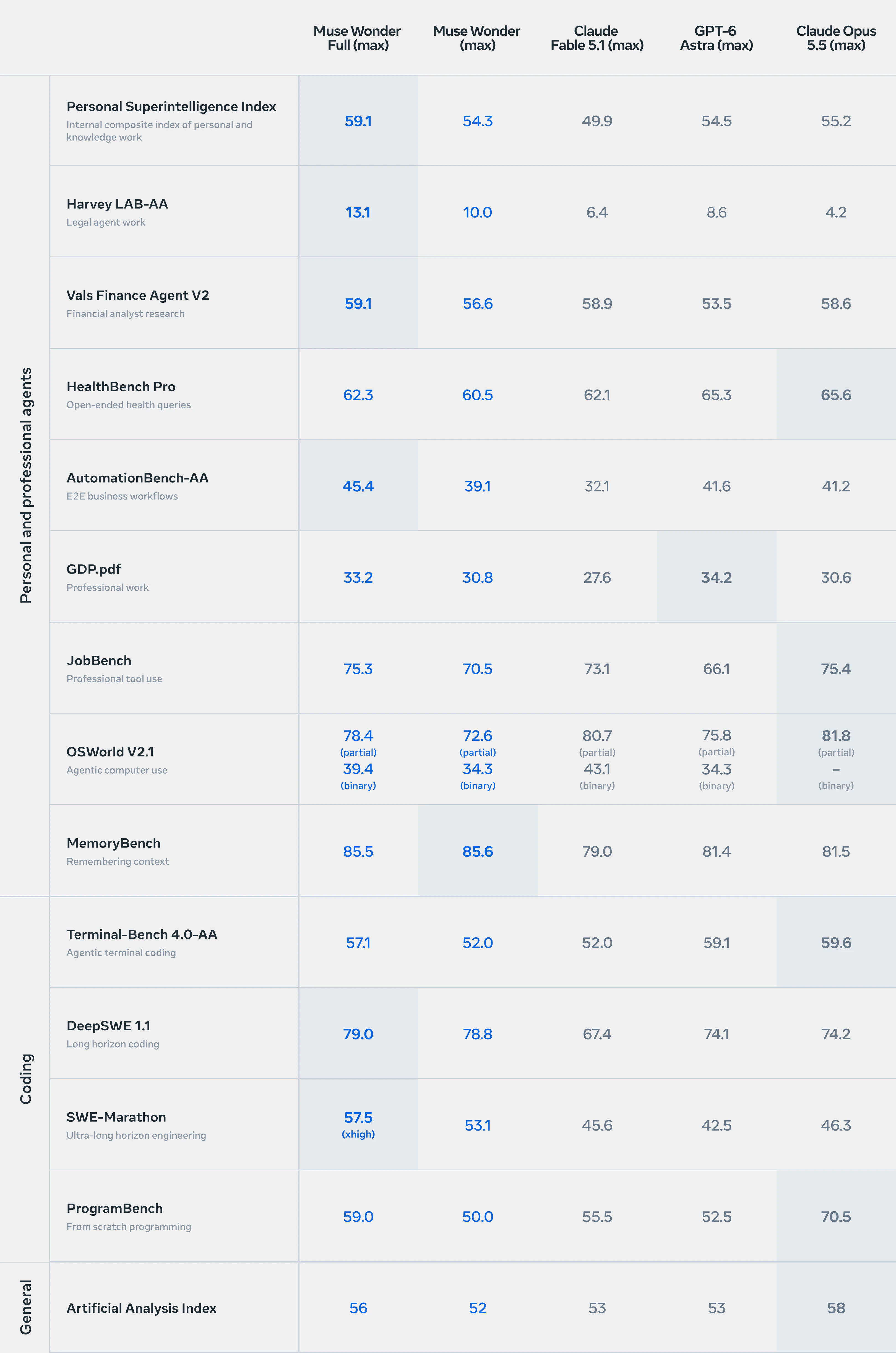
On Meta's own table, Wonder Full leads on DeepSWE, SWE-Marathon, Harvey LAB-AA and the internal personal-agent index. It trails Opus 5.5 on Terminal-Bench, ProgramBench, OSWorld and the Artificial Analysis Index.
Independent results
- Artificial Analysis: Intelligence Index v4.3 scores of 52 (Wonder) and 56 (Wonder Full), versus 48 for Muse Spark 1.3 (post). Wonder Full ranked "#1 on CritPt (33%) and GDP.pdf (33%)" and "#2 on GDPval-AA v2.1 (1857 Elo)" (post). Knowledge is a weak spot: on AA-Omniscience, Wonder Full scores 30 and Wonder 25, versus 46 for Opus 5.5 and 43 for GPT-6 Astra (post).
- Arena: Muse Wonder (Max) entered "Text Arena at #2 with 1513 pts" and "Code Arena: WebDev at #15 with 1651 pts" (post).
- Paweł Huryn, real-bug test (105 bugs across 2 repos): Muse Wonder 1.0 (max) scored 31.7 versus 45.0 for GPT-6 Astra (post). Muse Wonder Full 1.0 (max) scored 44, second only to Astra at 45 (post).
- Dan Shipper, Every's senior engineer benchmark: "Muse Wonder gets 52%—far behind event GPT-Sol 6.1 at 71%" (post). See our GPT-6.1 Sol vs GPT-6 Astra comparison for more on Sol.
Vendor tables are run by the vendor, and Wonder vs Wonder Full gaps matter. Re-test on your own work.
Early real-world reactions
Reactions were sharply split:
- Tobi Lütke (Shopify): "This model is very very good. I was struggling to find anything to throw at it that it couldn't do, even when other top models failed. Meta is back." (post)
- Ethan Mollick: "it seems like a good model from limited test" (post)
- Aaron Levie: "What a crazy time in AI with Meta now jumping fully into the frontier." (post)
- Bindu Reddy: "Muse Wonder is nowhere near Fable or Astra level" (post)
- HN user jjcm, on an image-to-HTML test: "It's much worse than Opus 5.5." (comment)
- ABOVO.co, on pricing: "Meta came to match the frontier's price, not to undercut it." (post)
Watch on YouTube: "Meta Muse Wonder Is HERE – Is THIS an Opus Competitor?" by Bijan Bowen
Third-party video by Bijan Bowen, an independent creator. AI Takeaway did not make this video and is not affiliated with its creator.
No time to watch the whole review? AI Takeaway is a tool that works on any YouTube video, including third-party reviews like this one. Paste the link to get the key points in minutes, jump to the original timestamps, and ask follow-up questions; every answer cites the video. You can also read our Hub summary of Muse Wonder: Zuckerberg and Wang's $100B AI.
Who should use Muse Wonder
- Muse Code users on a budget: Wonder is included from the $5 Everyday plan.
- Long-horizon coding and agent work: Wonder Full's best official results are on DeepSWE and SWE-Marathon, but it requires the $50 or $200 plan, and weekly limits apply.
- API builders: Wonder at $4 / $20 with no long-context premium is easy to trial. Independent results so far are mixed, so benchmark it against your current model.
- Probably not for: knowledge-heavy Q&A, where AA-Omniscience shows a gap, or anyone who needs open weights.
How it compares (briefly)
At $4 / $20, Muse Wonder's API price sits above GPT-6.1 Sol ($2 / $10) and Google's Gemini 4 Argon at its launch price ($2 / $10 through November 30). It is below GPT-6 Astra ($10 / $50). On Meta's table, Wonder Full edges Astra and Opus 5.5 on DeepSWE but trails them on Terminal-Bench.
Getting started checklist
- Decide which model you need. Wonder is on the API and every Muse Code plan; Wonder Full is only on Power or Maximum.
- For the API, call
muse-wonder-1.0on Meta Model API (OpenAI SDK compatible, per Meta). - For Muse Code, install the CLI and pick a plan. Expect five-hour and weekly resets.
- Run 50–100 of your real tasks, and compare cost per finished task against your current model.
- Re-check the pricing page before committing.
Keep up without the watch time
Muse Wonder, Gemini 4 Argon and GPT-6.1 Sol all landed within weeks of each other, and more launches, interviews and reviews keep coming. If you would rather read than watch, the AI Takeaway video summary hub has free curated summaries of AI and tech interviews, for example:
- Muse Wonder: Zuckerberg and Wang's $100B AI
- Sam Altman on Astra, AGI, and the future of OpenAI
- Gavin Baker on Orbital Compute, TSMC, and Frontier Models
To keep up with ongoing AI news, check the Hub regularly. You can also install the AI Takeaway Chrome extension to get key points right on YouTube, or submit any YouTube video yourself on aitakeaway.net.
For more model guides and comparisons, browse all AI Takeaway articles, including Gemini 4 Argon and GPT-6.1 Sol vs GPT-6 Astra.
FAQ
How much is the Muse Wonder subscription?
Muse Code plans cost $5, $15, $50 and $200 per month. Muse Wonder is included on all of them; Muse Wonder Full only on the $50 Power and $200 Maximum plans. Benefits may vary by region.
Can I use Muse Wonder Full through the API?
No. Only muse-wonder-1.0 (Muse Wonder) is on Meta Model API. Wonder Full is subscription-only in Muse Code.
How much does the Muse Wonder API cost?
$4 per million input tokens, $0.20 cached and $20 output, with no long-context premium.
What are Muse Wonder's benchmark scores?
On Meta's table, Muse Wonder (max) scores 78.8 on DeepSWE 1.1 and Muse Wonder Full 79.0. Artificial Analysis measured Intelligence Index v4.3 scores of 52 (Wonder) and 56 (Full).
Is Muse Wonder open source?
No. Meta says the Muse Wonder models are too large for many people to use, citing potential safety concerns as well; open weights are coming for Muse Spark instead.
Sources
- Meta, Muse Wonder launch blog (Oct 12, 2026) and model card
- Meta for developers: Muse Wonder model page, pricing and rate limits, Muse Code subscription help, build with Muse Wonder, Muse Code
- Meta, Muse app page
- X: Mark Zuckerberg, AI at Meta, Artificial Analysis, Arena, Paweł Huryn, Dan Shipper, Tobi Lütke, Bindu Reddy
- Hacker News: Muse Wonder discussion